
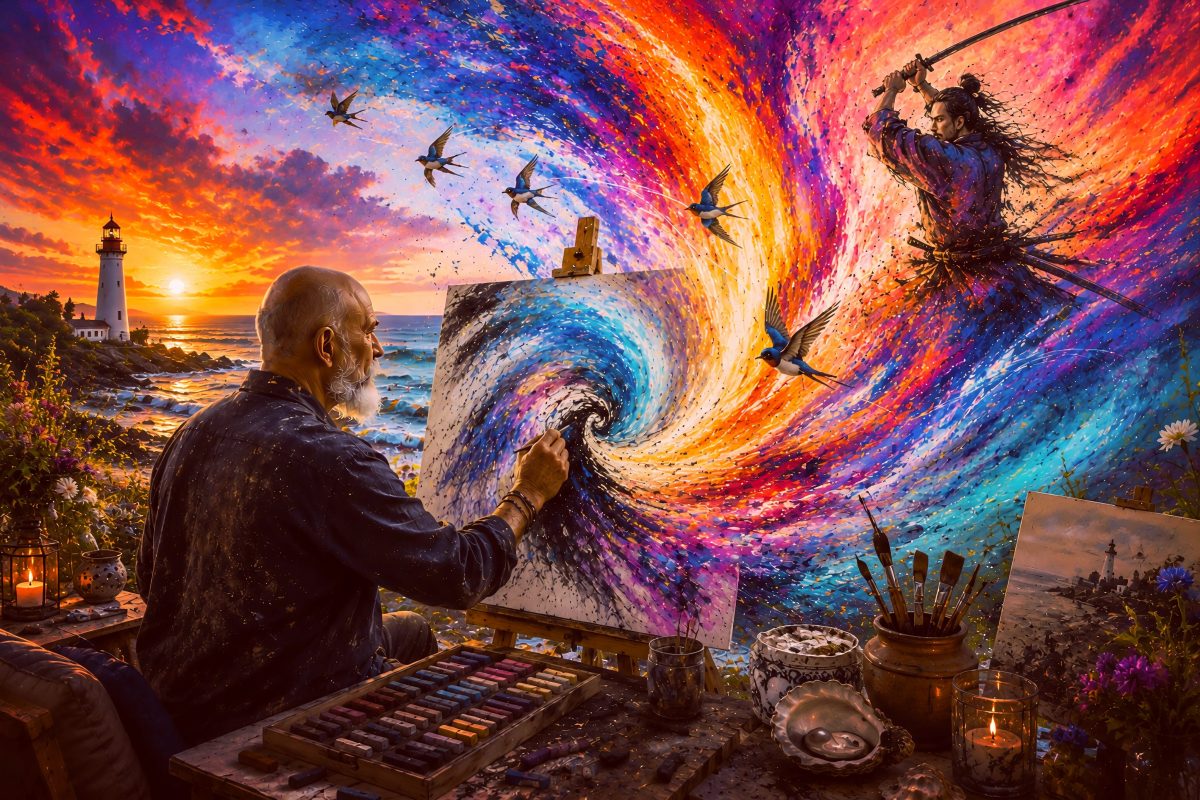
Exploring Frequency in Art
In a recent exchange with my friend and co-author in Norway, Kari Enes, we found ourselves circling an intriguing question: does art carry an energetic frequency? Not merely in the poetic sense, but as something perceptible, transmittable, and perhaps even intentional. It is a question that sits somewhere between philosophy, intuition, and lived creative experience, inviting us to look beyond technique and into presence.
At its simplest, frequency can be understood as vibration. Everything, from sound to light to the human body, exists in a state of oscillation. Even on a cosmic scale, our Sun is not static as it journeys through the galaxy, but moves in a subtle oscillation as it orbits the centre of the Milky Way. From the infinitesimal to the immense, there is a constant movement, a rhythmic pulsing that underpins existence. If this is true, then it seems reasonable to ask whether artworks, composed of colour, material, gesture, and form, might also hold and emit a kind of energetic signature. Standing before a painting, we often feel something before we analyse it. There is an immediacy, a resonance, a subtle stirring that precedes thought. Could this be the frequency of the work meeting our own?
Colour is perhaps the most accessible entry point into this idea. Even without invoking scientific frameworks, we know instinctively that certain colours evoke particular states. Deep blues can calm, reds can energise, yellows can uplift. But beyond these general associations lies something more nuanced. The way colour is applied, layered, softened, or intensified can shift its energetic presence entirely. A muted palette may whisper, while saturated tones can feel almost declarative. In this way, colour is not static; it vibrates according to intention and handling.
Composition, too, plays a role in shaping frequency. The arrangement of elements within a work can create harmony or tension, openness or density. A balanced composition might invite stillness, while asymmetry can provoke movement or unease. The eye travels through a piece in a rhythm set by the artist, and this rhythm contributes to the overall energetic experience. It is not just what is seen, but how it is encountered over time.
Then there is medium and form. Charcoal, with its immediacy and capacity for both bold gesture and soft erasure, carries a raw and honest energy that I have long been drawn to. Pastel offers a different kind of vibrancy, where pigment sits close to the surface, alive and tactile. Personally, I find there exists an enchanting balance and synergy when combining these two mediums, yet other media bring their own frequencies into play. Oils, with their richness and slow drying time, invite depth, blending, and contemplation. Acrylics, more immediate and versatile, can move between translucency and opacity with ease, often reflecting a more dynamic pace. Watercolour, by contrast, has an almost fluid intelligence, flowing and settling in ways that require both guidance and surrender. Each medium holds a distinct energetic quality, and when combined with intention, becomes a conduit through which frequency can be expressed.
This brings me to a personal realisation that emerged during the early days of lockdown, when I began recording a series of artistic YouTube sessions titled My Artsy Musings. What started as a simple, conversational journey of making art soon revealed something deeper. As I spoke and created simultaneously, the artworks seemed to take on an energy and coherence of their own, unfolding in ways that felt less directed and more received. It was as if I had become a participant within a larger creative current, rather than its sole originator. Prior to each session, I would set an intention, inviting a particular energy or frequency into the space. What followed often felt like a quiet collaboration between that intention, the medium, and something beyond conscious control.
This sense of energy in motion is not unfamiliar to me. My many decades immersed in the martial arts, particularly traditional Japanese sword arts, have offered a parallel understanding through the concept of Ki, often described as a vital life force or animating energy. In the practice of Kata, where form and technique are repeated with precision and awareness, there is a palpable sense of energy being shaped, directed, and expressed. Each movement is both physical and energetic, requiring presence, intention, and flow. In many ways, this mirrors the act of drawing or painting, and even dance, where form becomes a vessel for something less tangible yet deeply felt.
Does the artist’s frequency translate into the artwork? Increasingly, I believe it does. The state of being in which a work is created seems to imprint itself onto the final piece. When an artist is rushed, distracted, or disconnected, the work can feel unsettled. Conversely, when creation arises from a place of presence, attentiveness, and openness, the result often carries a sense of coherence and quiet vitality.
This is where mindfulness and presencing become powerful tools. To create with awareness is to enter into a relationship with the work as it unfolds. It involves slowing down, noticing breath, or life force, sensing the body, and allowing intuition to guide. In such a state, the artist is not imposing form onto the medium but collaborating with it.
Infusing art with frequency, then, is not about applying a formula. It is about cultivating a way of being. Before beginning, an artist might take a few moments to centre themselves, to become aware of their internal state. During the act of creation, they might remain attentive to shifts in feeling, in energy, in response to what is emerging on the page or canvas. Afterward, there may be a period of reflection, of simply sitting with the work and sensing what it holds, perhaps even instilling the intention of value in the artwork.
For the viewer, engaging with art in this way also invites a different kind of attention. Rather than asking “What does this mean?”, one might ask “What do I feel?” or “How does this affect my inner state?” In doing so, the experience of art becomes less about interpretation and more about connection.
Perhaps the notion of frequency in art is really about acknowledging something fundamentally experiential. It opens a space where creation and perception meet in a shared field of awareness. In that space, art is no longer just an object, but a living exchange, a quiet pulse moving between artist, artwork, and observer.
Guy McGowan
WASA representative in Durban KwaZulu-Natal
Chairperson of North Coast Artists, KwaZulu-Natal.