

Conversations with John Cogley: a lifelong passion for pigment
Owner and CEO of Daniel Smith Artists materials, John Cogley, visited South Africa during the week of 20 – 23 May 2023. He gave interactive talks about Daniel Smith Extra Fine Watercolor paints in Johannesburg, George, Hermanus and Cape Town. The event was hosted by Prime Art & Graphics, importers and distributers of Fine Art and Graphics supplies.
John was very enthusiastic to share the essentials of his products and to interact with the attending artists. Not only did he delve deeper into the technicalities of how his pigments and ingredients are manufactured and how they react in his paints. He also found it extremely important that we did not leave the presentation before having a full understanding of how to read and interpret all the necessary information on his color charts and paint tubes.
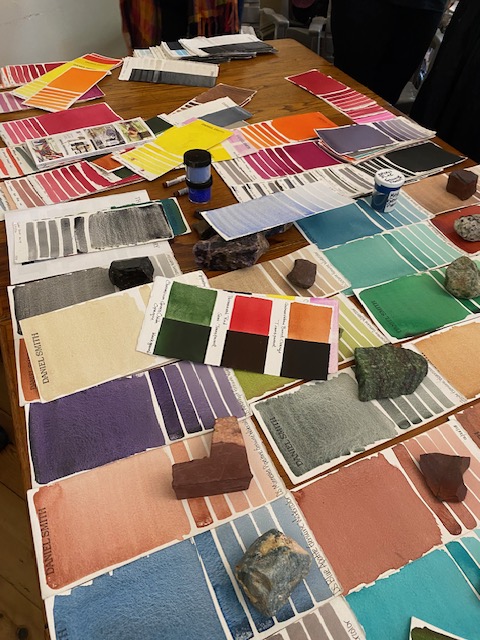
Each registered attendee received a very handy Daniel Smith Extra Fine Watercolor color chart and an accompanying dot chart with 266 colors to explore. Extra reading material included a brochure explaining how the Daniel Smith company manufacture their own watercolor paints. There was also a brochure on sourcing the minerals and manufacturing Daniel Smith Prima Tek Watercolor paint. A 5ml sample tube of Prima Tek Serpentine Genuine and a quinacridone gold watercolor stick with the newer PO 48 + PY 150 formulation was given to the attending artists to try. Prime Art and Graphics supplied a choice of hot pressed or cold pressed Primeart watercolor paper and synthetic hair Art Bianco Brushes. Alternatively people could bring their own brushes. The artists also got a squirt of highly granulating lunar black and separating cascade green to test and play with. Each registered attendee was entered into the lucky draw and was eligible to win a Daniel Smith hamper on the day of the event.

Background: Daniel Smith founded the company in 1976. His aim was to manufacture printing inks with better lightfastness and slower drying times. John Cogley joined the IT department of the Daniel Smith company in 1988. Being required to understand all the different departments, John became fascinated and “fell in love” with the manufacturing department. He worked his way up to management and eventually president. In 2008 he bought the company from his “friend and mentor” Daniel Smith. He finds it very satisfactory to manufacture products that “artists use to create beauty”. These two colourmen have shared a “passion for pigment” and consider themselves to be “working in a pigment company… that makes paint”. John explained that he loved his job and the people he works with. Some of the newest staff in the company have already been there for 10 years “people just don’t resign”. “We are a tight knit group.”
Types of paints and pigments: Daniel Smith manufactures a variety of paints and paint mediums however, it is best known internationally for the professional artist quality watercolor paints. What distinguishes Daniel Smith Extra Fine Watercolor from other watercolor brands is the “unique and daring approach to pigment”. He even sent their mineralogist, Bruce who has been working for them for 30 years, to far places including Afghanistan and Brazil… Some places have been so remote that Bruce had to travel by mule to “identify high quality veins of newly found ores”. Risks involved with manufacturing paint, include consistency and availability. To prevent running out of a specific pigment or variation of a mineral, it might happen that the company will buy up the entire lot of pigments or minerals. An example of overstocking includes buying up all the remaining automotive pigment, quinacridone gold PO 49. By the time Daniel Smith company finally ran out of their best selling pigment 17 years later, it was replaced with a blend of quinacridone orange PO 48 plus nickel azomethine yellow PY 150. This was the same pigments used in the complimentary quinacridone gold Watercolor sticks that artists received to try out at the presentation.
John explained that he is introduced to about 15 new pigments per month. He feels he is able to manufacture just about any paint. It is “easy to make paint” just use the necessary “steps and standards”. However, John needs to make considerations before he starts manufacturing. This includes if the product will sell, and at which price. He always considers if it would “serve the needs of the customer”.
Legal standards: Other factors that determine if new pigments or products get manufactured is toxicity of pigments. This refers both to the end user and also to the staff making the products. For this reason toxic cadmiums were phased out of the Daniel Smith ranges.
Sourcing and Manufacturing: John explained that he was approaching this presentation and talk from his perspective as a technical colourman or colorist, not as an artist. He pointed out that some terminology he used had a different meaning in the technical world of pigment manufacturing, as opposed to the context in which fine artists use them. This included terms such as “hue” as indicated on some paint tubes. Because John moved away from using toxic pigments such as cadmium, he created or mixed colors similar to the original colors and called it a “hue” or close replica of that particular color. Other terms and concepts that differ between the two worlds include terms such as “tone” “shade” “saturation point”. John also mentioned that in the technical world of color and pigment manufacturing, more time would be spent using a spectrophotometer and a fadeometer than an artist’s color wheel.
Seeing that John owns four different types of companies that enable and contribute to the manufacturing of Daniel Smith products, he has full insight and control over the final outcomes of Daniel Smith Extra Fine Watercolor paints. One of the unique ranges that Daniel Smith Watercolors offer is the Prima Tek Watercolor range. It is made with authentic mineral pigments that offer exciting color and texture separation with extraordinary granulating effects. John mentioned that the single pigment paint names get chosen by the creator. As set out in his brochures, John shortly summarized how mineral rocks are processed for the Prima Tek Watercolor range.
Prima: refers to “primitive” “Native American…natural materials…clays and minerals”.
Tek: refers to “modern machine technology” “unparalleled consistency”.
Process of sourcing and milling minerals for Prima Tek paints:
- Sourcing the minerals
- Mineral in their large or massive state “Milling these is hard work and also finding the right particle size, large, gritty, dull…”
- Jaw mill crushes rocks to reduce its size
- Hammer mill breaks size down further
- Ball mill uses almond shaped silica based balls where the minerals are gently crushed in a way that prevents it from losing its crystal prism and natural shine. Some minerals can tumble for up to 3 months
- Purification and concentration. In some cases the impurities on the rocks might be acceptable such as Minnesota pipestone. But when manufacturing garnet for example he will remove the impurities with an acid.
John is very proud of his “awesome specimen collection” of crystal minerals or rocks. The minerals are sourced from Brazil, Alaska, Africa, Australia, Canada, Chile… He mentioned that he does not buy any minerals from Asia and that he does not take minerals into the USA without the necessary paperwork. The Prima Tek brochure set out where each mineral come from and what the characteristics of the final paint is. While some pigments come from a single source, other minerals might come from more than one source such as lapis lazuli. While the source in Afghanistan offer a jewelry grade standard which is quicker to process, it is also more expensive to buy and reliant on political stability. The source in Chile is cheaper to buy, but takes more time and money to produce. In some cases the same mineral can give different results even if the two mines are in the same area, as is the case with Sleeping Beauty Turquoise found in different mines in Arizona.
Besides the Daniel Smith standard range and Prima Tek water colour ranges, there are also four types of luminescent pigments:
- Iridescent: metallic paint that reflects light.
- Pearlescents: transparent glaze that add opalescent sheen.
- Interferences: transparent pigments that works on the principle of refraction. Light is scattered differently depending on where the light comes from and how dark or light the background is.
- Duochromes: a single pigment that bounces between two colours.
Natural mineral pigments such as ochres, iron oxides, ultramarines, cadmiums and the minerals found in the Prima Tek range comes from the earth. This larger, more irregular particles easily lends itself to granulation where the pigment particles clump together rather than settling evenly on the paper surface.
Sourced from automobile and other industries are the manmade synthetic pigments created in laboratories, such as phthalo and quinacridones. This more evenly sized particles, nearly perfect in uniform shape, size, weight and behavior give smoother paint washes with superior lightfastness and strength.
Manufacturing the final tubes of paints: is done under the supervision of floor chemists and batch makers. A short summary of the process is as follows: pigment – gum arabic acting as a binder and distilled water that contains no contaminants – Vessel – Mixing station – Dispersion Mill or Roll Mill where repeated milling cycles ensure that pigments are perfectly dispersed. The final result is approved by a floor chemist – Filling station – Labeling station – Finished watercolor tube.
Paint characteristics:
Daniel Smith Extra Fine Watercolor paint consist of pigment, distilled water and gum arabic. John is very specific about the quality of the ingredients and he always tries to use the best available grade of ingredients for his paints. Impurities found in the ingredients can cause inconsistencies in the paint performance, potentially make the paints chemically unstable and go against required legal standards. For this reason distilled water is used instead of tap water, as it does not contain impurities and additives such as chlorine and fluoride. Pharmaceutical grade gum arabic, from acacia trees in Africa are used. Gum arabic acts as a binder and helps prevent granulation.
Other factors that will affect the paint, for example ultramarine blue and french ultramarine blue, is the grinding process. Ultramarine blue is ground down to a smaller particle size and appears cooler and greener due to the way the light hits the particles. French ultramarine consist of larger particles that granulates heavily and appear warmer and redder.
The reason why quinacridone PV19, often referred to as permanent rose, can vary from a red-pink to a deep violet is due to chemistry. Daniel Smith offer the largest range of synthetic organic quinacridones ranging from rich golds, oranges, pinks, reds to violets. The term quinacridone refer to a total 3 benzene plus 2 pyrite rings totalling 5. This very popular range of intensely vibrant, luminous, transparent colors has excellent lightfastness and permanence.
John grinned when he explained that sometimes a new or unique paint simply evolve because it was a mistake. For example shadow violet.
For most of the attending artists, John Cogley’s visit all the way from Seattle was an opportunity of a lifetime. There were lots of samples to explore and vast amounts of technical knowledge to absorb. Most of all we were able to interact with the man behind the products.
– blog by WASA member Renee Morkel